
Vol. 3 No. 3 (2025): Jurnal Ilmiah Gema Perencana

					View Vol. 3 No. 3 (2025): Jurnal Ilmiah Gema Perencana

In this Volume 3 Number 3, January-April 2025, the JURNAL ILMIAH GEMA PERENCANA published twelve (12) articles; eleven (11) articles came from Planners within the Ministry of Religious Affairs of the Republic of Indonesia and have been declared to have passed the Minimum Work Results (HKM) as one of the assessment requirements to take the Competency Test (Ujikom) implemented by the Center for Development, Education and Training of Planners (Pusbindiklatren) Bappenas RI and 1 (one) article is the result of research from Krida Wacana Christian University, Jakarta, Indonesia. The ten articles are presented according to the scope and focus that has been determined by the Editorial Team of the JURNAL ILMIAH GEMA PERENCANA. The articles that appear in this Journal emphasize the study of "Planning Policy" (Policy Paper) and "Research Results" (Research Paper) in the fields of: Social, Economic, Spatial, and Education, from a Religious and Religious perspective.

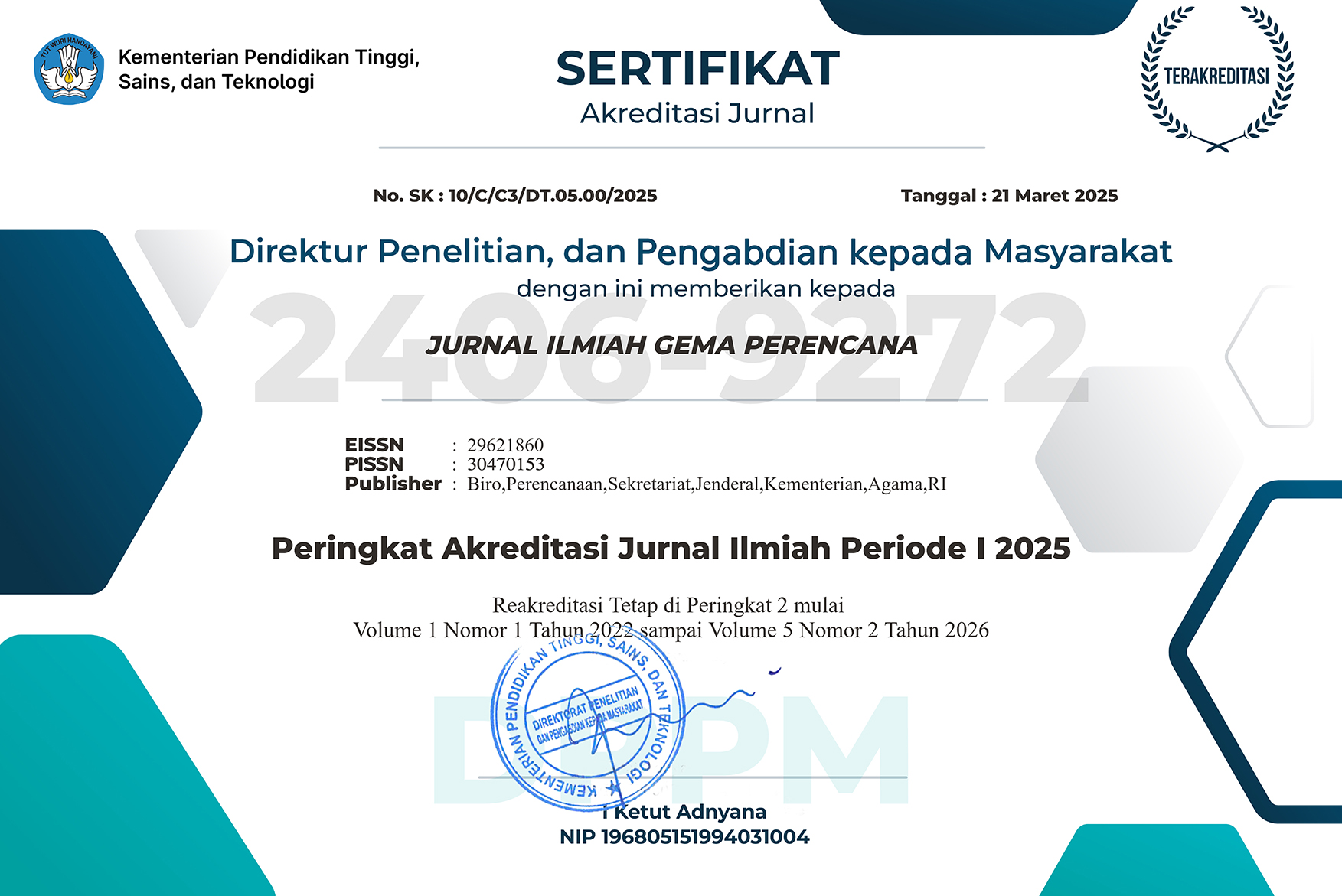
Based on the Minutes of Determination of the Results of Journal Accreditation Period I of 2025, the Decree of the Director General of Higher Education, Research, and Technology Number 10/C/C3/DT.05.00/2025 dated March 21, 2025, concerning the Accreditation Ranking of Scientific Journals Period I of 2025 has been issued that the Jurnal Ilmiah GEMA PERENCANA has achieved the SINTA 2 (S2) predicate.

Published: 04/10/2025

Article

  • Governance of Public Service Agency in State Islamic Religious Universities

    Abstract:

    This Policy Paper describes the policy of the Public Service Agency (BLU) at State Islamic Religious Colleges (PTKIN) as mandated in the Regulation of the Minister of Finance Number 129/PMK.05/2020 of 2020 concerning Guidelines for the Management of Public Service Agencies, which aims to improve autonomy, efficiency, and quality of education services. The purpose of this policy analysis is expected to contribute to the development of a more effective BLU management policy at PTKIN. This paper uses a qualitative writing method with an approach to descriptive analysis of various data sources related to the BLU implementation policy at PTKIN. The results show that implementing the BLU policy at PTKIN has brought significant changes in the management of higher education. However, the implementation of this policy faces various challenges, such as changes in organizational culture, limited human resources, difficulties in adapting competitive business models, limited infrastructure, and regulatory complexity. This study analyzes these challenges and proposes several alternative innovative solutions, such as strengthening governance, increasing HR capacity, diversifying revenue sources, developing research-based business models, utilizing digital technology, and enhancing cooperation with industry. It is hoped that these efforts will provide the widest possible positive impact on prosperity in institutional transformation in higher education, which will continuously give rise to improvements in the quality of public services.

  • Strategy to Improve Education Quality and Responsivity to Social Emergencies Through Contingency Planning at UIN K.H. Abdurrahman Wahid Pekalongan

    Abstract:

    This Policy Paper explains that improving the quality of education is determined by various factors, namely curriculum, materials, research, and the role of universities in community development and development. However, to realize this is hampered by a management system that is not ready to face changes and emergency conditions. The purpose of this study is to build a contingency planning strategy to support universities in improving the quality of education through their participation in society and development, especially in terms of participation in overcoming social emergencies. This study was conducted using a qualitative approach. The data used in this study are primary data, namely observations and secondary data through reports, journals, and other written documents. The results show that: 1) the success of universities in improving the quality of education is also reviewed from the role and relevance of their research in dealing with crucial issues in society so that universities will become a reference in decision-making; 2) the way to increase the role of universities is through contingency planning so that the role and relevance of research are adjusted to crucial problems that arise suddenly or their role in helping to participate in overcoming social emergencies in society; and 3) to build a contingency planning strategy, collaboration can be carried out between PESTEL analysis which reviews external elements and Resource Based View analysis which reviews potential resources in higher education.

  • Productive ZIS Distribution Policy Strategy for Empowering Micro, Small and Medium Enterprises in Bengkulu Province

    Desrizaldi Jambak ID
    https://doi.org/10.61860/jigp.v3i3.183
    Abstract:

    This policy paper explains that Bengkulu Province has great potential in developing Micro, Small, and Medium Enterprises (UMKM), but still faces various challenges, such as limited capital and management capacity. On the other hand, the potential for collecting Zakat, Infak, and Sedekah (ZIS) funds in Bengkulu is also quite large. Therefore, the distribution of productive ZIS can be a strategic solution to empower UMKM and encourage regional economic growth. This article aims to analyze the potential and challenges of distributing productive ZIS for empowering UMKM in Bengkulu Province, formulate effective policy strategies, and provide recommendations for policy implementation. This paper uses a qualitative method with a descriptive analysis approach and SWOT (Strengths, Weaknesses, Opportunities, Threats). Data were obtained through in-depth interviews with stakeholders, including ZIS institution managers, UMKM actors, local government representatives, and experts in the field of sharia economics to explore information on the potential and challenges of distributing productive ZIS, UMKM needs, and perceptions and expectations related to effective policy strategies. The results show that the potential for collecting and distributing ZIS funds in Bengkulu has not been optimally utilized. The distribution of ZIS funds is still dominated by consumptive activities, whereas the distribution of productive ZIS can provide a greater and more sustainable impact on UMKM. Therefore, an effective policy strategy is needed to increase the distribution of productive ZIS, including distribution models, monitoring mechanisms, and synergy with local government programs and other financial institutions.

  • The Impact of Self Efficacy and Career Development on Employee Performance with Work Motivation as Mediation Variables (The Case Study on Secretary General of the Ministry of Religious Affairs)

    Fransiskus Haris Leonard ID , Bernard T. Widjaja ID , Eka Desy Purnama ID
    https://doi.org/10.61860/jigp.v3i3.179
    Abstract:

    This study aims to analyze the effect of self-efficacy on employee performance, analyze the effect of career development on employee performance, analyze the effect of work motivation on employee performance, analyze the effect of self-efficacy on work motivation, analyze the effect of career development on work motivation, analyze the effect of self-efficacy on employee performance through work motivation, analyze the effect of career development on employee performance through work motivation. The method in the study was based on interviews and questionnaires. The sample processed was 227 employees obtained from the Slovin formula. The study was conducted using a descriptive analysis method using a questionnaire. The method of calculating this data will be processed using the Smart PLS application. The results of this study are that Self-Efficacy has a positive and significant effect on employee performance (employees at the Secretariat General of the Ministry of Religious Affairs of the Republic of Indonesia). Career development has a positive and significant effect on employee performance (employees at the Secretariat General of the Ministry of Religious Affairs of the Republic of Indonesia). Work motivation has a positive and significant effect on employee performance (employees at the Secretariat General of the Ministry of Religious Affairs of the Republic of Indonesia). Self-Efficacy has a positive and significant effect on work motivation.

  • Digitalization Management Strategy: As an Action in the Integration of Religious Information Systems

    Andi Sugiharta ID
    https://doi.org/10.61860/jigp.v3i3.166
    Abstract:

    This policy paper describes how one of the missions of the Indonesian Ministry of Religious Affairs for 2025-2029 is to "improve the understanding and practice of moderate and welfare-oriented religious teachings" in conjunction with the Ministry of Religious Affairs' 2024 outlook program, namely winning the digital competition can be realized as a form of recommendation at the 2024 Ministry of Religious Affairs National Working Meeting (Rakernas). The purpose of this policy paper is to discuss the potential of digitalization management as an action plan and the Ministry of Religious Affairs' strategy in utilizing it for the integration of digital-based religious information systems. With a qualitative approach, this policy paper emphasizes the descriptive-analytical method by analyzing secondary data from various sources, such as scientific journals, news articles, and official documents of the Ministry of Religious Affairs. In general, the results/data of this policy analysis show that digitalization management has proven effective in spreading messages of preaching and education to the broader community, especially the younger generation who are active in the digital world. The Ministry of Religious Affairs has a great opportunity to utilize digitalization management as a tool to strengthen religious moderation, increase religious literacy, and build a positive image of religion in the digital era. The alternative policy is to develop interesting and innovative religious information integration content, involving all aspects of the Ministry of Religion's integration utilizing popular digital platforms and collaborating with influencers and religious communities.

  • Policy for Improving the Quality of Budget Planning of the Ministry of Religious Affairs

    Abstract:

    This policy paper describes that Work Plan and Budget (RKA) is one of the instruments in the implementation of the State Budget (APBN) to support national development. Each Ministry/Institution (K/L) prepares the RKA as a reference in budget implementation based on their respective needs to achieve the goals and targets that have been set. However, in its implementation, sometimes there is a gap between the RKA and budget implementation, which can hinder the achievement of goals. This paper aims to identify and analyze the causes of this gap. The methodology used is a qualitative descriptive approach, which includes literature studies, interviews, and participatory observations in budget preparation. The discussion of the paper shows that several factors contribute to the mismatch between planning documents and budget realization. The quality of planning documents often does not reflect real needs and policy priorities. In addition, the lack of accurate and up-to-date data is a challenge in preparing a quality RKA. The use of information systems that are not optimal is also a problem because many processes still rely on manual methods that are prone to errors. This paper provides suggestions in the form of developing an integrated information system that can improve accuracy, transparency, and efficiency in the budget planning and implementation process.

  • Policy for Improving the Quality of One-Door Integrated Services (PTSP) at the Ministry of Religious Affairs Office of Purbalingga Regency

    Abstract:

    This Policy Paper describes the One-Stop Integrated Service (PTSP) at the Purbalingga Regency Ministry of Religious Affairs Office as a bureaucratic reform strategy to improve the efficiency, transparency, and accountability of public services. This study aims to identify efforts to optimize the quality of PTSP services by analyzing policies, processes, and supporting and inhibiting factors. This paper uses a qualitative method with a descriptive analysis approach, where data is obtained through document studies, interviews, and observations. The results of the study indicate that the implementation of PTSP has had a positive impact on service time, reduced bureaucratic procedures, and increased public satisfaction. However, several challenges remain, such as limited competent human resources, inadequate technological infrastructure, and lack of public understanding of service procedures. The optimization efforts identified include strengthening human resource capacity through ongoing training, modernizing information technology systems to facilitate access to services, and increasing socialization in the community. In addition, collaboration with external parties, such as educational institutions and religious organizations, is also a key strategy to support the success of this policy. The policy recommendations provided include allocating an adequate budget for the development of PTSP, simplifying regulations that hinder service efficiency, and implementing an evaluation system based on key performance indicators (IKU) to ensure the sustainability of quality improvements.

  • Policy to Increase the Proportion of Non-Primary Income for BLU PTKIN: Reducing Dependence on Tuition Fees through Business Unit Empowerment

    Herlinda Nifia AO
    https://doi.org/10.61860/jigp.v3i3.177
    Abstract:

    This policy paper presents a study on the policy of increasing the proportion of revenue from non-educational services (supporting services) at State Islamic Religious Colleges (PTKIN) with the status of Public Service Agency (BLU). The purpose of this study is to achieve the target of BLU management, namely to provide financially sustainable public services. The writing methodology used is qualitative with a descriptive approach, utilizing secondary data and SWOT analysis to identify internal and external factors that influence the management of supporting business units at PTKIN BLU. The results of the study indicate that the low proportion of BLU revenue is caused by two main factors, namely: suboptimal management of business units and limited human resource competencies. Based on these findings, several alternative policies are proposed, including the development of industry-based research and innovation clusters, internal and external regulatory reforms for the professionalization of business unit management, reform of the organizational structure of business units, and diversification of business unit types. The main recommendation proposed is internal and external regulatory reforms for the professionalization of business unit management. These are addressed to the Ministry of Finance as the BLU Financial Supervisor and the Ministry of Religious Affairs.

  • Guidance Program for Marriage-Age Youth Evaluation Program in the Midst of the Rise in Marriage Dispensation Applications in Aceh Province

    Afrizal Ilyas Hasan ID
    https://doi.org/10.61860/jigp.v3i3.173
    Abstract:

    This policy paper explains that adolescents are in a transition period and are vulnerable to violations due to bad company. Thus, many requests for marriage dispensation are made due to mistakes and violations committed by adolescents. The high number of marriage dispensations is inversely proportional to the existence of the School Age Adolescent Guidance (BRUS) program. The purpose of this study is to conduct a critical analysis of the evaluation of the BRUS program in achieving the tasks and development of adolescents and the phenomenon of the many requests for marriage dispensation in Aceh Province. This study was conducted using a qualitative approach. The data used are primary and secondary. Data were analyzed using the countenance stake and AHP models. The results of the study: 1) the implementation of the BRUS program still has many obstacles, namely lack of budget, limited quality and quantity of human resources, lack of facilities, lack of innovative materials, no consistency in budget allocation, evaluation errors; 2) evaluation with countenance stake produces information that weaknesses in the BRUS program began since the development of policies that did not analyze resources, so the program was implemented with various resource limitations, both tangible and intangible resources; 3) Evaluation using stake countenance resulted in 6 (six) policy issues that were selected for their urgency weight using AHP and obtained the development of resources as human capital that needs to be transformed. Human capital is developed with strategic positioning, human resource accountability, human resource technology, and human resource competence.

  • Character Education Evaluation in Madrasah Aliyah and Policy Proposals for Community-Based Character Education Development

    Abstract:

    Cases of violence, brawls between students and moral degradation are caused by character education failure, due to inappropriate learning process, not emphasizing tasks and development of adolescents and personality structure model, the lack of parents’ role and society and stakeholders. The purpose of this study is to conduct a critical analysis about character education evaluation in Islamic high schools so that it can reduce the number of brawls, violence between students and moral degradation of adolescents; and to propose a policy for developing character education based on community collaboration. This study was conducted using a qualitative approach. The data used are primary and secondary data. Results: 1) the implementation of character education in Islamic high schools in the Special Region of Jakarta cannot be used as a solution to overcome the problems of violence, brawls between students and moral degradation; 2) The weaknesses of character education implementation are analyzed using the Wisconsin version of the logic model to obtain six alternative policies; 3) the sixth alternative policy is chosen as a policy, namely the development of character education with community collaboration so that it can increase community awareness to overcome social problems involving students. Conclusion: the development of character education requires collaboration with parents, the community and stakeholders to apply these values ​​to real conditions and solve social problems in the community.

  • Building an Effective Supervision System for PPIU: Policy for Enhancing Trust and Quality of Umrah Services

    Abstract:

    This policy paper outlines the main issue faced in the implementation of umrah pilgrimage trips, which is the weak supervision of the operational activities of Umrah Travel Agencies (PPIU), posing high risks to service quality, unclear departure schedules, and low transparency. The main objective of this policy is to provide recommendations to strengthen the supervision of PPIUs through the enhancement of existing regulations, as well as to improve transparency and accountability in PPIU operations. The methodology used in this study is a qualitative approach with in-depth analysis of policies and case studies of various incidents that have occurred in the industry. The analysis results show that weak monitoring systems, lack of financial transparency in PPIUs, and insufficient regulations governing PPIU operations are the primary causes of these problems. In general, the proposed policy involves strengthening supervision, establishing service quality standards, and implementing strict certification for PPIUs. Thus, the author concludes that this policy plays an important role in improving the supervision system and enhancing the quality of PPIU services, ensuring better protection for Umrah pilgrims. The author recommends that the Ministry of Religious Affairs immediately issue regulations concerning the Standards of Quality and Supervision for Umrah Travel Agencies (PPIU).

  • Digital Transformation of the Office of Religious Affairs in Buton Tengah Regency: Infrastructure and Policy Evaluation

    Abstract:

    This policy paper examines the digitalization of public services as a strategic step in increasing efficiency and transparency. However, its implementation at the Office of Religious Affairs (KUA) of Central Buton Regency still faces various obstacles. The main problem identified is the limited technology infrastructure caused by several main factors, including unstable internet access and frequent disruptions that hamper the operation of applications, such as the Marriage Management Information System (SIMKAH), so that the process of marriage services operates a digital system. The main objective of this policy paper is to analyze the inhibiting factors for the digitalization of KUA and to formulate policies that can optimize the implementation of technology-based services. This paper uses a qualitative method with a descriptive-analytical approach to data collected from: literature studies, in-depth interviews, surveys, and policy analysis using the SWOT approach and evaluation of alternative policies based on the criteria of effectiveness, efficiency, and sustainability. The analysis results show that the lack of an internet network, limited technological devices, and lack of employee training hamper the efficiency of administrative services at KUA. Based on the evaluation of alternative policies, the issuance of the Minister of Religion Regulation (PMA) on technology infrastructure standards and digitalization of KUA services was chosen as the most effective solution to accelerate digital transformation. Based on the results of the analysis, it is recommended that the Indonesian Ministry of Religion immediately issue a PMA to ensure the optimal sustainability of the digitalization of KUA services.