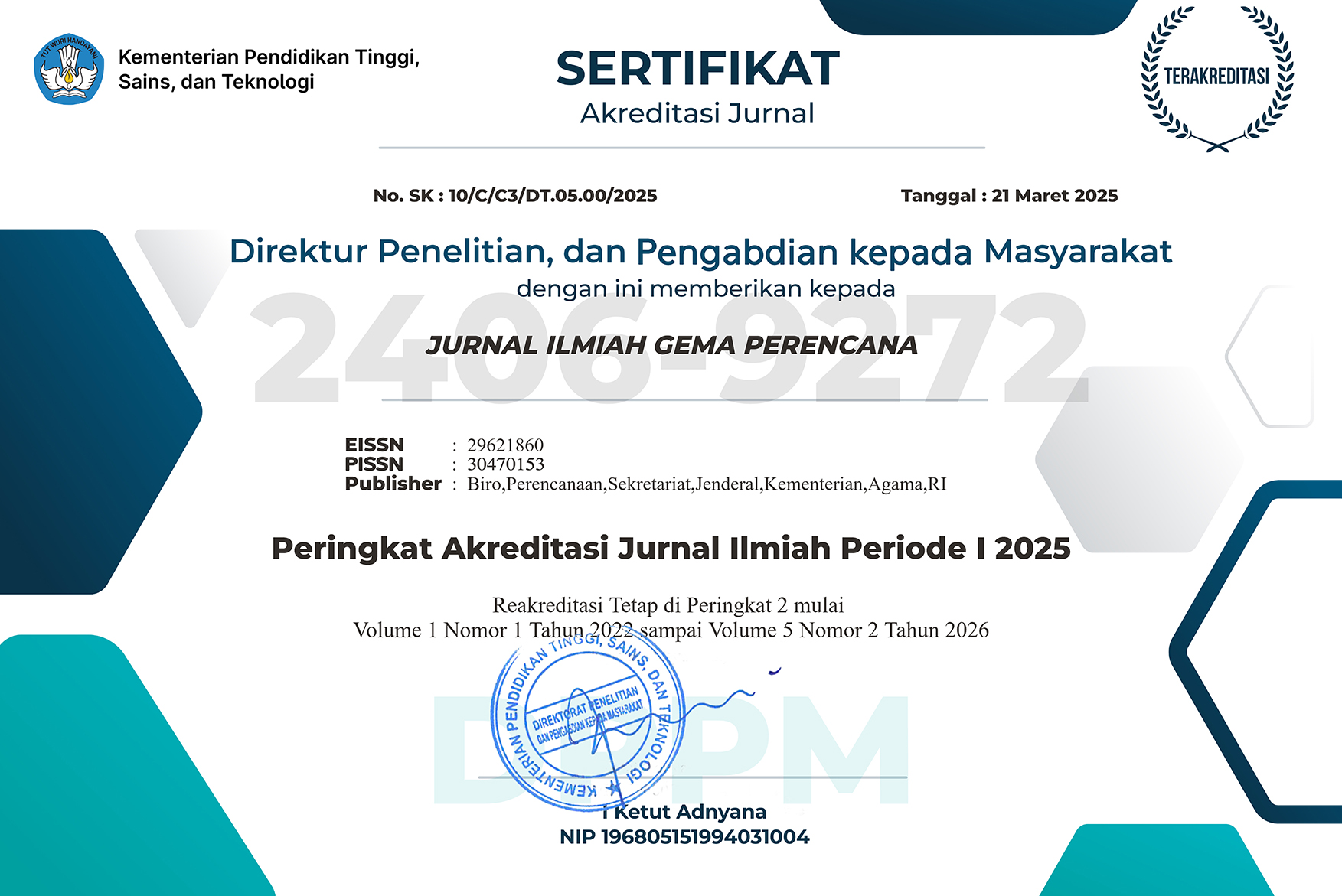

INDEXED
OPERATOR
POLICIES
SUBMISSION
INFORMATION
In Volume 2, Issue 2, September-December 2023, the Jurnal Ilmiah GEMA PERENCANA published 9 (nine) articles, all of which came from planners within the Indonesian Ministry of Religious Affairs. The twelve articles are presented in accordance with the scope and focus that has been determined by the Jurnal Ilmiah GEMA PERENCANA Editorial Team. The articles that appear in this journal emphasize the study of "Policy Paper" in the study of: Social, Economic, Spatial and Education, from the perspective of Religion and Religious Affairs.
This article is a policy paper resulting from analyzing and identifying the low performance of employees implementing Religious Data Management at the Office of the Ministry of Religious Affairs of North Hulu Sungai Regency. The problems encountered are: (1) Religious data managers do not yet have adequate expertise, skills, and abilities; (2) The duties and functions of Religious Data Management Employees have not been carried out effectively and efficiently; and (3) Low discipline, loyalty and responsibility of Religious Data Managers in carrying out their duties. This article was written using a qualitative method with a descriptive analysis approach, to obtain relevant data according to the problem that was the object of study accompanied by secondary data analysis and direct interviews conducted in-depth (in-depth interviews). In general, this policy analysis data shows that of the 13 districts/cities in South Kalimantan Province, the North Hulu Sungai Regency Ministry of Religious Affairs Office experienced delays in data collection until the specified deadline. This results in hampered performance of religious data, both at the Provincial Regional Office level and reporting at the central level.
This policy paper reviews religious moderation as one of the Ministry of Religious Affairs priority programs as stated in the Ministry of Religious Affairs’s Strategic Plan for 2020-2024. This paper uses a qualitative method with a descriptive analysis approach, where data is collected, grouped, and analyzed using descriptive analysis. Data shows that starting in 2019, the Ministry of Religious Affairs began pioneering programs to mainstream religious moderation to enlighten in the context of developing religious perspectives, attitudes, and practices with a middle way, creating and building peace, respecting diversity, respecting human dignity, and upholding adab. the glory of human life which is manifested in an attitude of life that is trustworthy, fair, full of compassion, tolerance, without discrimination, and mutual respect for diversity. In efforts to increase religious moderation, religious moderation agents are needed who act as agents who spread important echoes or echoes of the implementation of religious moderation in everyday social life, so that harmony can be created between and among religious communities. Thus, the author recommends strengthening religious moderation not only within the scope of the Ministry of Religious Affairs, Ministries/Institutions, and local governments, but it is also important to create religious moderation agents by involving stakeholders, such as religious leaders and community leaders in society.
This article describes planning and budgeting as a small part of the cycle of state financial management in Indonesia. IAIN Madura as a government agency and part of the State Islamic Religious College (PTKIN) under the Ministry of Religion of the Republic of Indonesia continuously strives to improve the quality of state financial management amid the dynamics of the nation's economy through the planning and budgeting process. The purpose of this study is to determine the stages of planning and budgeting at IAIN Madura and to analyze it from the point of view of state finances. The research method uses a descriptive qualitative approach. Data collection through observation and in-depth interviews with interested parties. The data used are planning and budgeting documents in the form of strategic plan documents, work plans, and DIPA, RKA-K/L. The results showed that IAIN Madura in the process of planning and budgeting had followed the rules and regulations that were in force.
This policy paper explains that, currently, Indonesia is experiencing a significant shortage of headmen. The available principals only reach 55% of the ideal number of requirements. This policy paper aims to recommend appropriate policies so that the needs of Penghulu in Indonesia can be met so that public services at KUA run smoothly and the Public Satisfaction Index with KUA services increases. This article was written using qualitative methods with a descriptive analysis approach to provide an in-depth picture of the problem of the shortage of chiefs and policies to overcome it. From the results and analysis of the strengths and weaknesses of each proposed policy, policy recommendations can be obtained that can be implemented by stakeholders.
This policy paper discusses the gap between the number of students and the number of academic staff at UIN Sayyid Ali Rahmatullah Tulungagung. Excellent academic service must be supported by adequate quality and quantity of academic human resources (HR). As a Public Service University, UIN Sayyid Ali Rahmatullah Tulungagung provides both academic and non-academic services. To provide these services, adequate human resources are needed. Academic staff spearhead services to the students and society in general. The author tries to find a solution to the rapid increase of the number of students which is not followed by the increase of the number of academic human resources. This condition causes the ratio of the number of students to the available academic staff to be less than ideal. It has an impact on the quality of the services provided. Fast and friendly services are hard to achieve. Using descriptive qualitative methods, the author analyzes the sources of problems and looks for solutions to these problems. As a result, the author recommends: 1) the university leader limit the selection quota for new student admissions; 2) the university leader build an application system that is integrated into one web, Android, and IOS-based database system; 3) the university leader involves other parties in providing certain services; and 4) the university leader uses the Management Cooperation (MC) method in managing the non-academic business so that available human resources can focus more on academic services as the core business of PSA of UIN Sayyid Ali Rahmatullah Tulungagung.
This policy paper reviews the strategic role of Output Cost Standards in improving performance-based budgeting in the Ministry of Religious Affairs to improve the quality of budget planning. This study uses a qualitative method with a descriptive analysis approach regarding the motives for implementing the Inspectorate General's Output Cost Standards and the motives for refusing to implement the Output Cost Standards in other units. This study is expected to provide accurate information about trends in the motives for implementing SBK. Apart from that, the author also wants to dig deeper by analyzing the effectiveness of the use of SBK at the Inspectorate General to support the role of Output Cost Standards in improving Performance-Based Budgeting in their units for the reasons: (1) knowing the motives for implementing Output Cost Standards in preparing and reviewing performance-based budgets, (2) evaluate the achievement of outputs and outcomes as well as the efficiency of implementing Output Cost Standards, and (3) analyze motive factors and evaluate Output Cost Standards in improving the quality of performance-based budgeting. The aspects studied show the: motives for implementing Output Cost Standards, evaluation of the implementation of Output Cost Standards at the Inspectorate General, and the strategic role of Output Cost Standards in improving Performance-Based Budgeting.
This policy paper describes the influence of expenditure on professional services and transportation of celebrants at the District KUA, especially in out-of-office wedding services, on the performance and budget burden on the Directorate General of Islamic Community Guidance. This step is an effort to mitigate and resolve budgeting problems through the reconstruction of PNBP-NR management. However, in its implementation, it turned out to conflict with several related policies. In studying this problem, the author uses a qualitative method as an interpretive method, because the research data is more concerned with the interpretation of data found in the field. In general, the data in this study shows that the initial aim of implementing the allocation of costs for professional services and transportation for marriage service officers outside the office was to minimize illegal fees and gratuities. This policy was implemented because the budget posture at the Directorate General of Islamic Community Guidance was unbalanced, where budget logistics from Pure Rupiah funding sources were mostly used for routine office operational expenditure, while the majority of non-operational activity allowances were charged to PNBP-NR funding sources, whose budget revenues based on the number of wedding events held outside the office, so the planned work program will not be able to run if the source of PNBP-NR revenue is not reached according to the target.
This policy paper aims to obtain policy recommendations regarding the problem of establishing places of worship that are experiencing obstacles in the implementation process in the community. Regulations regarding the establishment of places of worship, namely Joint Regulations of the Minister of Religion and the Minister of Home Affairs Number 9 and Number 8 of 2006, actually become an obstacle due to conditions that are difficult to fulfill, especially for adherents of certain religions and beliefs. Embracing a religion or belief and worshiping in accordance with that religion or belief are human rights that must be protected by the state. This paper uses qualitative research methods by collecting data through interviews, observation, and documentation studies. The results of the study show that there are regulations that hinder the establishment of places of worship. Existing regulations cannot protect and facilitate the establishment of places of worship. Narrow religious understanding results in the absence of religious freedom in the process of establishing places of worship. There is a discriminatory attitude towards certain religions. There is still an understanding that adherents of certain religious minorities cannot build houses of worship in areas where adherents of the majority religion live. Therefore, a policy is needed that can make it easier and protect adherents of religions or beliefs from being able to build houses of worship in accordance with the teachings of their religion and beliefs.
This policy paper reviews the School Operational Assistance Fund, or BOS for short, namely government funding for schools. The BOS funds are a form of the Indonesian government's attention to quality education, but in their management, there are still irregularities. Therefore, this article discusses BOS fund management policies to improve madrasa education and to minimize all forms of fraud and ineffectiveness in its management in Kerinci Regency. So, a strategy is needed to effectively manage BOS funds to improve the quality of madrasa education in Kerinci Regency. This article uses a qualitative writing method with a descriptive analysis approach to obtain relevant data according to the problem that is the object of study, accompanied by secondary data analysis and direct interviews conducted in-depth (in-depth interviews) with seven (seven) heads of Madrasah Ibtidaiyah, Madrasah Tsanawiyah, and Madrasah Aliyah, both public and private. The results of this study show that there is ineffectiveness in the management of BOS funds in Kerinci Regency due to non-compliance with procedures, weak comprehensive monitoring and evaluation, and inadequate public complaint tools for the misappropriation of funds. The Kerinci Regency Ministry of Religious Affairs Office has not yet prepared a public complaint tool for the misappropriation of BOS funds. To ensure that BOS funds are on target, socialization, evaluation, and monitoring are needed both internally and externally by the school. Transparent, accountable, and professional policies are very necessary.
INDEXED
OPERATOR
POLICIES
SUBMISSION
INFORMATION
PUBLISHED BY: POKJANAS PERENCANA Collaborate BIRO PERENCANAAN DAN PENGANGGARAN KEMENTERIAN AGAMA REPUBLIK INDONESIA
Licensed By: Attribution 4.0 International License