INDEXED


OPERATOR


In Volume 3 Issue 2, September-December 2024, the Jurnal Ilmiah GEMA PERENCANA publishes 8 (eight) articles, all of which come from Planners within the Ministry of Religion of the Republic of Indonesia and have been declared to have passed the Minimum Work Results (HKM) as one of the assessment requirements to take the Competency Exam (Ujikom) implemented by the Center for Development, Education and Training of Planners (Pusbindiklatren) of Bappenas RI. The eighth articles are presented according to the scope and focus determined by the Editorial Team of the Jurnal Ilmiah GEMA PERENCANA. The articles in this Journal emphasize the study of "Planning Policy" (Policy Paper) in the fields of: Social, Economic, Spatial, and Education, from a Religious and Religious perspective.

This policy paper describes that the main actors in the stunting reduction policy in Indonesia are families through Marriage and Family Guidance in Islamic, Christian, Catholic, Hindu, Buddhist, and Confucian communities. Based on the evaluation and findings, a review of this policy and program is needed. The findings in this paper indicate that there is potential for ineffectiveness in the stunting reduction program. The purpose of this paper is to evaluate the effectiveness of the Ministry of Religious Affairs's policy on the marriage and family guidance program in reducing stunting rates. The results show that there are various factors that cause the performance of the stunting reduction budget to be suboptimal, namely the inaccurate preparation of performance indicators and the lack of coordination of budget planning with related work units. For this reason, the author recommends the importance of (1) providing training for employees or human resources in the planning bureau or work units related to planning and budgeting at the Ministry of Religious Affairs related to stunting reduction; (2) carrying out coordination and collaboration related to budget planning by involving the Planning Bureau with related work units regarding the suitability of budget logic and performance indicators in reducing stunting; (3) create policies on reducing stunting at the Ministry of Religious Affairs by optimizing the Marriage and Family Guidance program through rational, effective, accurate, and targeted budget acceleration, so that the impact can be felt directly by the community.
This Policy Paper describes that public services at the Religious Affairs Office (KUA) have received a lot of corrections from the community in West Nusa Tenggara Province. About this, KUA services will be improved by using KUA revitalization. However, the implementation of KUA revitalization has many obstacles that cannot be resolved in a short time. The purpose of this analysis is to evaluate and develop the KUA revitalization program in West Nusa Tenggara Province. This analysis was carried out using a qualitative approach, and data analysis using a descriptive approach. The analysis results are: 1) The KUA revitalization program is not only an Islamic Guidance program but a comprehensive Ministry of Religious Affairs program. 2) KUA revitalization is not only a change in mindset and culture set but also an agent of change. 3) The main change in KUA revitalization is in changes in human resources. 4) Improvement of facilities and infrastructure is carried out based on the priority scale of KUA conditions. 5) It is necessary to make changes to the rules that are linear with the KUA revitalization program, especially the rules related to SBSN so that they can synergize to accelerate the progress of KUA revitalization. The conclusion is that the KUA revitalization program will be successful if there is cooperation between all work units within the Ministry of Religious Affairs.
This policy paper describes the family counseling policy to shape children's character through a da'wah approach by Religious Counselors in Mamuju Regency, West Sulawesi. This article aims to present a family counseling program that has a strategic role in forming children's character by assisting Islamic Religious Counselors to parents using a da'wah approach. This study uses qualitative methods in managing data obtained through interviews and direct observation, both from primary and secondary sources, then conducting in-depth interviews and field observations which are analyzed in detail regarding the role of Islamic Religious Counselors in carrying out child counseling. This policy paper reveals that family counseling policies aim to shape children's character by adopting a da'wah approach that includes forms of da'wah, such as bil-hikmah, bil-mau'idzah, and bil-mujjadi, as taught in the QS. an-Nahl [16]: 125. These findings imply that family counselors need to take the role of positive models who are full of empathy and promote honesty and patience in their words and actions. In addition, persuasive guidance is considered an effective approach to forming children's character through da'wah.
This Policy Paper reviews that learning in remote, outermost, and underdeveloped villages (3T) is hampered by accessibility issues. Accessibility is not only in terms of regional reach, but also economic, health, and environmental. The existence of accessibility that is considered severe has an impact on the quality of education which is categorized as weak. This problem is followed up by providing additional internet facilities to support information and communication facilities, but internet utilization has not been maximized. The purpose of this analysis is 1) to describe and analyze the problem of weaknesses in the use of internet technology as a learning tool, and 2) to analyze appropriate educational planning for remote villages. This analysis was conducted using a descriptive qualitative approach. The results of this analysis are 1) the use of the internet to support the learning process is considered not optimal due to the human resources of teachers and madrasah leaders who do not understand online learning, 2) the educational planning process is carried out as a solution to the weaknesses of implementation, namely by using synoptic theory and improving teacher pedagogical competence. The conclusion is that educational planning needs to be done to improve the output and outcome of the planned program.
This article reviews premarital marriage guidance for prospective brides and grooms as one of the government's priority programs that provide knowledge and skills for married couples to build harmonious and prosperous households that do not run effectively and efficiently between the output and outcome produced and those intended to be achieved in the implementation of premarital marriage guidance at the Ministry of Religion of West Nusa Tenggara Province based on hybrid learning, due to factors such as the quality of human resources, premarital marriage guidance materials, and limited access to technological devices and the internet. In this regard, in analyzing this problem, the author uses a qualitative approach method. The results of the analysis are: First, the quality of guidance requires a different approach, because the literacy skills of the participants in the guidance vary, and most still have difficulty understanding and following the marriage guidance material provided. Second, the level of public trust, especially in traditional communities that still believe in local wisdom patrons, who find it difficult to apply knowledge according to the marriage guidance material they obtain into their married lives. Third, not all prospective couples have adequate access to technological devices and the internet to follow the hybrid learning method, especially in remote areas or with limited digital infrastructure. The conclusion is that pre-marital marriage guidance for prospective brides and grooms needs to be developed to minimize the occurrence of divorce and build a harmonious family.
This policy paper examines the BOS fund planning and budgeting policies of private madrasahs with a focus on four main issues, namely: (1) transparency and accountability of fund management, (2) suitability of allocation to madrasah needs, (3) timeliness of fund disbursement, and (4) capacity of human resources managing BOS in madrasahs. This paper uses qualitative methods with a case study approach and policy analysis methods, including SWOT analysis, to identify internal (strengths and weaknesses) and external (opportunities and threats) factors that influence the effectiveness of the policy. The results show that although the BOS policy has made a positive contribution to increasing access to education, there are still several weaknesses that need to be addressed. Lack of transparency and accountability, mismatched allocation, late disbursement, and limited human resource capacity are the main challenges. Therefore, this study recommends several improvements, including: (1) strengthening the online information and publication system to increase transparency, (2) revising the fund allocation formula, and strengthening the process of preparing the Madrasah Work Plan and Budget (RKAM) based on needs, (3) simplifying the administrative process and improving coordination between agencies to accelerate fund disbursement, and (4) increasing human resource capacity through training and mentoring.
Higher education is the main pillar in producing superior, competitive human resources (HR), and able to drive sustainable national development. Conditions that are not yet in harmony occur in Central Kalimantan where the Gross Participation Rate for higher education in 2024 is still relatively low, which is 27.49%. This low Gross Participation Rate reflects the inequality of access to education between urban and rural areas. Factors that cause this low figure include Geographical and Accessibility conditions, Socio-Economic Conditions, Lack of Higher Education Institutions, Culture and Awareness of Education and Lack of Information and Assistance. The problem statement in this Policy Paper is the Socio-Economic Conditions of the community in Central Kalimantan. The writing of this Policy Paper uses a descriptive qualitative method, the data collection techniques used are observation, interviews, and documentation. The results show that the majority of the population of Central Kalimantan works in the informal and agricultural sectors, making income still low and vulnerable to social and economic inequality which has an impact on the low Gross Participation Rate. The policy options offered in this Policy Paper to overcome this problem are by creating technical guidelines for expanding affirmative programs by the Directorate General of Islamic Education, which is expected to be the best solution and policy alternative in resolving the problem of low participation in higher education.
This Policy Paper describes that the border areas in North Kalimantan have unique characteristics, in terms of geography, society, culture, and economy. Religious education in this area has a very important role in shaping the character of the community, strengthening national values, and supporting regional development. However, there are several challenges faced in the development of religious education in border areas, such as limited access to educational facilities, lack of qualified teachers, and the influence of foreign cultures. Therefore, religious education can be a catalyst in building a harmonious, tolerant, and competitive society. This paper analyzes the contribution of religious education to the development of border areas and formulates policy strategies that can strengthen the role of religious education in achieving development goals. This article uses a qualitative method that focuses on understanding the meaning and interpretation of social phenomena in border areas, with a descriptive-analytical approach to describe and analyze data in detail and in-depth. The results show that quality religious education can improve the quality of human resources, strengthen national values, and support regional economic development. Moreover, the management of the border area in North Kalimantan which directly borders Malaysia. Due to its proximity, there is significant cross-border interaction and activity among the people living in this area, especially the people in Malinau and Nunukan Regencies. So the role of religious education becomes a strategic significance in the formation of character and the face of the people in this inter-country region.
TEMPLATE RESEARCH PAPER

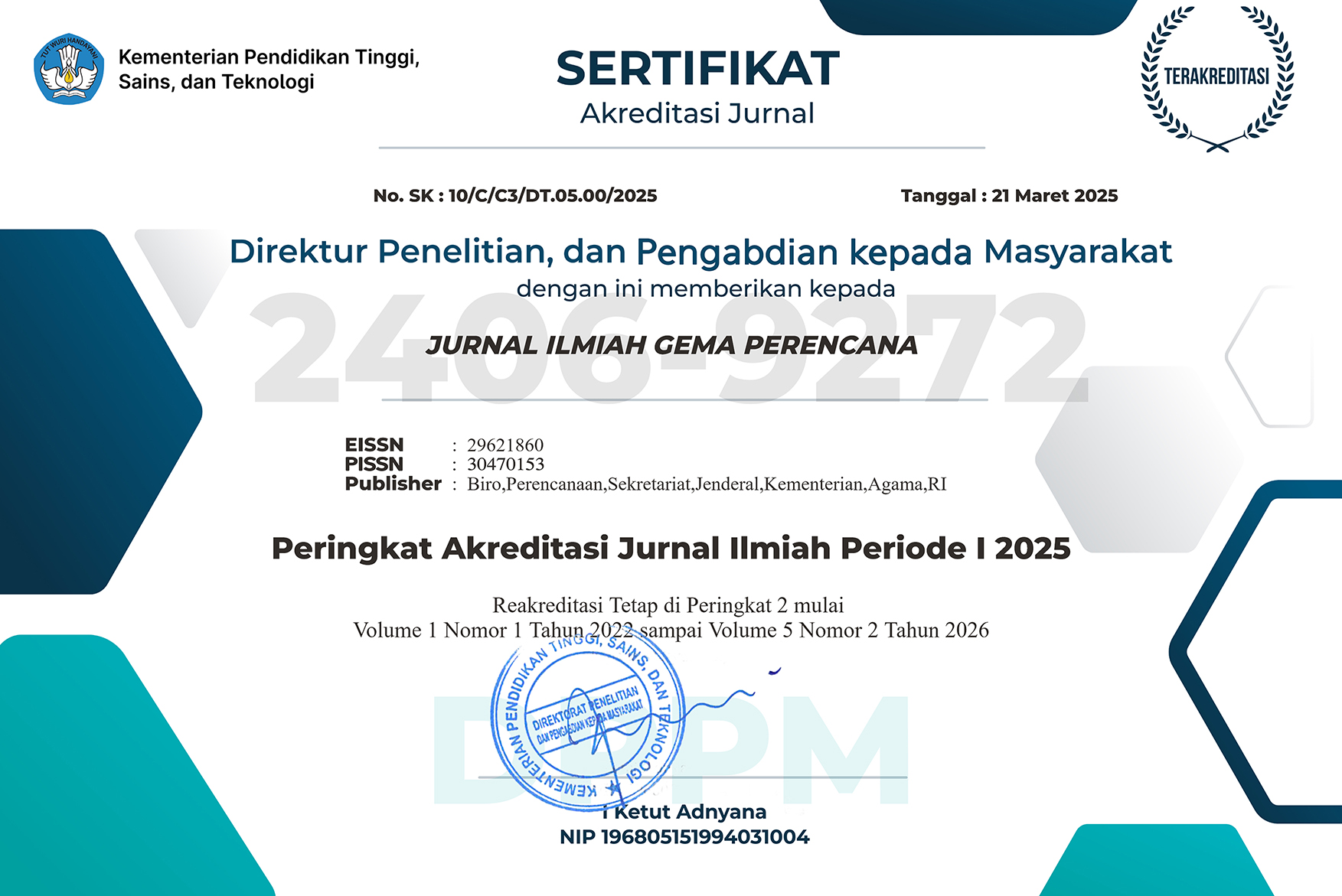
PUBLISHED BY: POKJANAS Collaborate BIRO PERENCANAAN KEMENAG RI
Licensed By: Attribution 4.0 International License

