INDEXED


OPERATOR


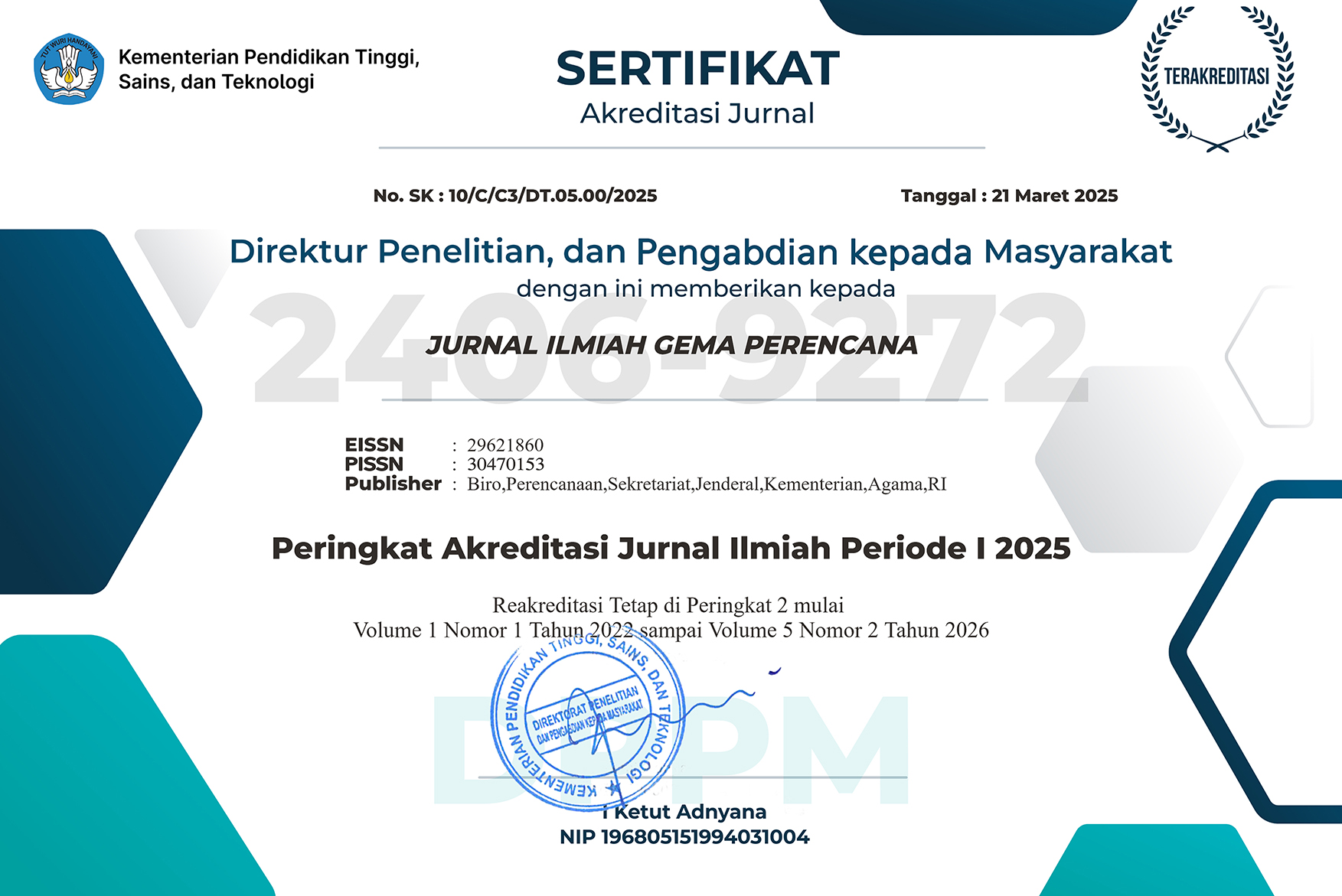
JURNAL ILMIAH GEMA PERENCANA, Volume 1, Issue 2, September-December 2022 can be published as First Edition after obtaining the E-ISSN (Electronic -International Standard Serial Number) from ISSN Indonesia National Center, National Research and Innovation Agency (BRIN).
In Volume 1, Issue 2, September-December 2022, the JURNAL ILMIAH GEMA PERENCANA published 5 (five) articles, all of which came from Planners within the Indonesian Ministry of Religion. The five articles are presented in accordance with the scope and focus that has been determined by the Editorial Team of JURNAL ILMIAH GEMA PERENCANA, where the discussion is related to the fields of: Social, Economic, Spatial, and Education, in the perspective of Religion and Religion.

The revitalization of the Sub-district KUA Religious Affairs Office is a priority program of the Minister of Religious Affairs of the Republic of Indonesia. The Cirebon Regency Religious Affairs Ministry office is required to implement the program. A strategy is needed to implement it so that the sub-district Office of Religious Affairs revitalization program in Cirebon Regency is running. The method in this article uses descriptive qualitative, namely direct observation and interviews with relevant stakeholders. There are three elements of strategy according to Richard P. Rumelt, namely diagnosis, guiding policies and coherent actions. The diagnosis found obstacles in the form of institutional infrastructure, material infrastructure, and personal infrastructure. Other problems are lack of cooperation between employees, lack of budget, location of KUA is also less strategic, and information services are not optimal. In the guiding policy a thorough evaluation is made in order to identify existing weaknesses, complaint services are strengthened, coordination is carried out internally and externally. Mapping of employees and revision of the existing budget. The coherent actions taken were through meetings, coordination and reviewing the existing and revised budgets. The Ministry of Religion office must strengthen coordination and evaluation and maximize its services.
Islam is a religion that came as rahmatallil alamin or as a mercy for all nature. His arrival is expected to bring love, happiness and perfect peace both in this world and in the hereafter. Along with the development Islam, the world also continues to experience developments in various aspects. There are three challenges in the MB strengthening process. First, development of excessive, overreaching, and extreme religious understanding and practice, the second challenge, emergence truth claims on religious interpretations. The third challenge is an understanding that actually undermines or threatens, even destroys national bonds. "To overcome this problem, Kemenag developed the concept of Religious Moderation. Religious Moderation is a perspective leads people to a middle way. This study uses descriptive qualitative research methods with data analysis techniques in this study is descriptive analysis. The results of the study This program divided into two parts, namely the first with regard to the implementation of the program strengthen religious moderation in Mojokerto City, starting with anxiety seeing the widespread misunderstanding between religious communities due issues and slander that often cannot be accounted for. Various efforts have been made to avoid conflicts and also to maintain peace,program efforts strengthen religious moderation through socialization are carried with various hopes create harmony and a tolerant society. Secondly related to the perception organizers the program to strengthen religious moderation as known that moderation Religion in the Ministry of Religion is a priority, because the current sketch of Indonesia depicts the existence of extremism, claims and intolerance.
The potential of zakat in efforts to alleviate poverty. Base on law number 23/2011, zakat is a potential source of funds for alleviating poverty. Zakat can function as working capital for the poor to be able to open jobs and entrepreneurship. Zakat does not eliminate the government's obligation to create welfare but only helps part of this government's responsibility to the community through the National Amil Zakat Agency (BAZNAS). The purpose of this writing is to explain the importance of empowering zakat in an effort to alleviate poverty. The distribution of productive zakat will not only raise the standard of living of the poor because they are already able to start their own business, it will also leverage the economy to be able to absorb local workers (reduce unemployment) and contribute to increasing economic growth. The method in this writing is analytical descriptive, which seeks to provide a clear picture of the main issues that exist, namely by methodologically analyzing the poor who receive zakat from BAZNAS. The Amil Zakat Institution is expected to be able to optimize muzakki data through the zakat data bank so that it can be more optimal in collecting zakat, as well as mapping zakat recipients and potential mustahik who have the ability to manage zakat to apply productive zakat distribution to people who will receive zakat. With the provision of zakat funds carried out by BAZNAS to the poor or those in need, it is very useful and the community really feels the benefits.
This study aims to analyze: 1) The influence of Competence, Work Discipline, and Work Culture partially on Employee Performance at the Sorong State Islamic Institute, 2) The influence of Competence, Work Discipline, and Work Culture simultaneously on Employee Performance at the Sorong State Islamic Institute, 3) The most dominant variable has an effect on employee performance at the Sorong State Islamic Institute. The results of the study show that: 1) Competence partially has a positive and significant effect on the Performance variable; 2) Partially, Work Discipline Variables have a positive and significant effect on the Performance variable, 3) Partially, Work Culture has a positive and significant effect on the Performance variable, 4) Simultaneously Competence, Work Discipline, and Work Culture have a positive and significant effect on performance, 5) Variables The most dominant that affects performance is Work Discipline, 6) The coefficient of determination shows that 53.7% of employee performance variables can be explained by independent variables, namely Competence (X1), Work Discipline (X2), Work Culture (X3) while the remaining 46.3% is explained by other variables outside the model. This study uses an associative approach with a quantitative model. Associative research according to Sugiyono (2013) is "research that aims to determine the relationship between two or more variables". According to Echdar (2017), the quantitative approach is "a method that places more emphasis on aspects of objective measurement of social phenomena, in which every social phenomenon is described in several problem components, variables, and indicators".
The Ministry of Religion Affairs has 3,000 Work Unit Offices managing 5,666 Dipa DIPA (budget implementation check list), it is known that the budget allocation for office operations and maintenance (002) of the Ministry of Religion is quite large. The Multi DIPA system currently used in Regional Office Work Units and Regency/City Offices makes the budget allocation for work unit operational fees (521115) large, reaching 12.1% of the operational expenditure ceiling (002). This study aims to determine the effect of the Multi DIPA System on the amount of the work unit operating fee budget at the Provincial and Regency / City Ministry of Religion Offices. With the method of implementing the One DIPA system scheme at the Ministry of Religion at the Regional and Regency/City levels, it can be seen that the current Multi DIPA system makes the operational expenditure budget of work units inefficient not in accordance with the principle of performance-based budgeting which emphasizes the concept of Value for money based on three main elements. , namely economy, efficiency, and effectiveness..
TEMPLATE RESEARCH PAPER

PUBLISHED BY: POKJANAS Collaborate BIRO PERENCANAAN KEMENAG RI
Licensed By: Attribution 4.0 International License

