INDEXED


OPERATOR


In this Inaugural Edition, JURNAL ILMIAH GEMA PERENCANA publishes 5 (five) articles, all of which originate from Planners within the Ministry of Religious Affairs of the Republic of Indonesia, as one of the complete requirements for e-ISSN (electronic International Standard Serial Number) to the ISSN Indonesia National Center - National Research and Innovation Agency (BRIN).
The five articles are presented in accordance with the scope and focus that has been determined by the Editorial Team of JURNAL ILMIAH GEMA PERENCANA, where the discussion is related to the Social, Economic, Spatial, and Educational studies, from a Religion and Religious perspective.
 , Imam Kurnianto
This research aims to analyze what is the cause roots of the increasing divorced rate caused by economy problems. The method use in this research is Root Cause Analysis (RCA). RCA is structure step by step technique that focused on find the cause of the problems and the solution rather than overcome the symptoms. This method good enough to help government understand the problems to achieve permanent solution. Applied RCA in this research is to inform what is happen (sourced from Badilag data where divorce rate is increasing): why did it happen (root of problems investigation analysis displayed in diagrams fishbone) and what is to be done to prevent something like that happening again (in the form of action plan).
, Agus Sunaryo
Absorption of the government's budget is one of the instruments for national economic recovery (PEN) during the COVID-19 pandemic. Proportionate budget absorption is able to increase consumption power and have an impact on people's welfare, this of course must be supported by quality planning and professional Human Resources. The budget absorption at the Ministry of Religion at the end of the year was included in the good category, but the lack of proportionate absorption every quarter was possible due to many factors including planning and human resources. The purpose of this study was to determine the effect of budget planning and human resources on budget absorption in the ministry of religion. Research method with quantitative multivariate correlation. Collecting data through a questionnaire by taking data on planning, human resources and budget absorption in 2020. The data was then analyzed using multiple linear regression analysis with the help of Partial Least Square (PLS). The results of the study show that the planning process and human resources at the Ministry of Religion are categorized as good. These two variables have an effect of 43.6% on budget absorption, while the other 56.4% are influenced by other factors not discussed in this study. This shows that planning and human resources are two inseparable variables and need attention in improving the quality of budget absorption during the pandemic.
Islamic boarding schools or pondok pesantren are non-formal educational institutions that have the characteristics of simplicity, obedience to the kyai, tenacity, independence and having social spirit. However, the independence of pondok pesantren is not only a way of life for students, but pondok pesantren must be able to empower the community with entrepreneurship so that economic independence can be realized. The Ministry of Religious Affair as an institution for fostering pondok pesantren has limitations in guiding and mentoring, especially to realize pondok pesantren independence. Thus the purpose of this paper is to provide a reference in the form of an implementable strategy to realize the independence of traditional pondok pesantren so that they can realize the transformation of people’s services. This research was conducted using a qualitative approach. Data analysis was carried out by SWOT analysis. The results of this study are 1) the independence of pondok pesantren can be realized by using a combination of strength and threat analysis strategies with a weight of 3.2; 2) priority activities are implementing entrepreneurship in tandem with learning, applying the principles of prudence, transparency and accountability as well as conducting risk analysis. Conclusion: The independence of pondok pesantren is not only to improve the quality of santri in terms of independence in carrying out the learning process, but also economic independence and community empowerment by improving the quality of life through improving the quality of the economy.
Management is a systematic science to understand why and how humans work together to produce something useful for other people and certain groups and society in general. The functions of management according to experts vary, but from all experts who argue about the function of management there are similarities. In this paper, the author describes the function of planning management in Islamic education. In the Qur’an there are lafad whose meaning is commensurate with management, namely lafad of which lafad (yudabbiru) in Surah Yunus/10:3 which means to regulate, that Allah is in control of everything that happens on this earth. The word planning is not found in qath’iyah (clear) lafad in the Qur’an, but many verses of the Qur’an that talk about lafad that are commensurate with the Qur’an, by definition educational planning is an effort that is systematically arranged in various ways to achieve future goals with pay attention to the economic, socio-cultural and overall fields of a country.
The distribution of the population in West Sumatra is almost over 80 percent of the Minangkabau indigenous people who are Muslim. The remaining 20 percent are non-Minangkabau people and have religions other than Islam, even if there are other ethnicities and religions, they can still live and live side by side. This ethnic and religious diversity needs to be managed to maintain diversity as the achievement of national goals. The purpose of this research is to examine more deeply the relationship model between Nias and Minangkabau ethnic groups in Padang City and Padang Pariaman Regency. The research method was carried out through a literature review through the search for secondary information. From the literature studied, it is known that malakok has been proven to be able to act as a model of local wisdom in relation to diversity, both ethnically and religiously based for social harmony, both internally Minangkabau and with non-Minangkabau who are Muslim and with non-Minangkabau who are not Muslim. Malakok, commonly referred to as the Minang kabaustyle assimilation. The existence of this malakok system means that the kinship system in Minangkabau proves that it is actually an open system.
TEMPLATE RESEARCH PAPER

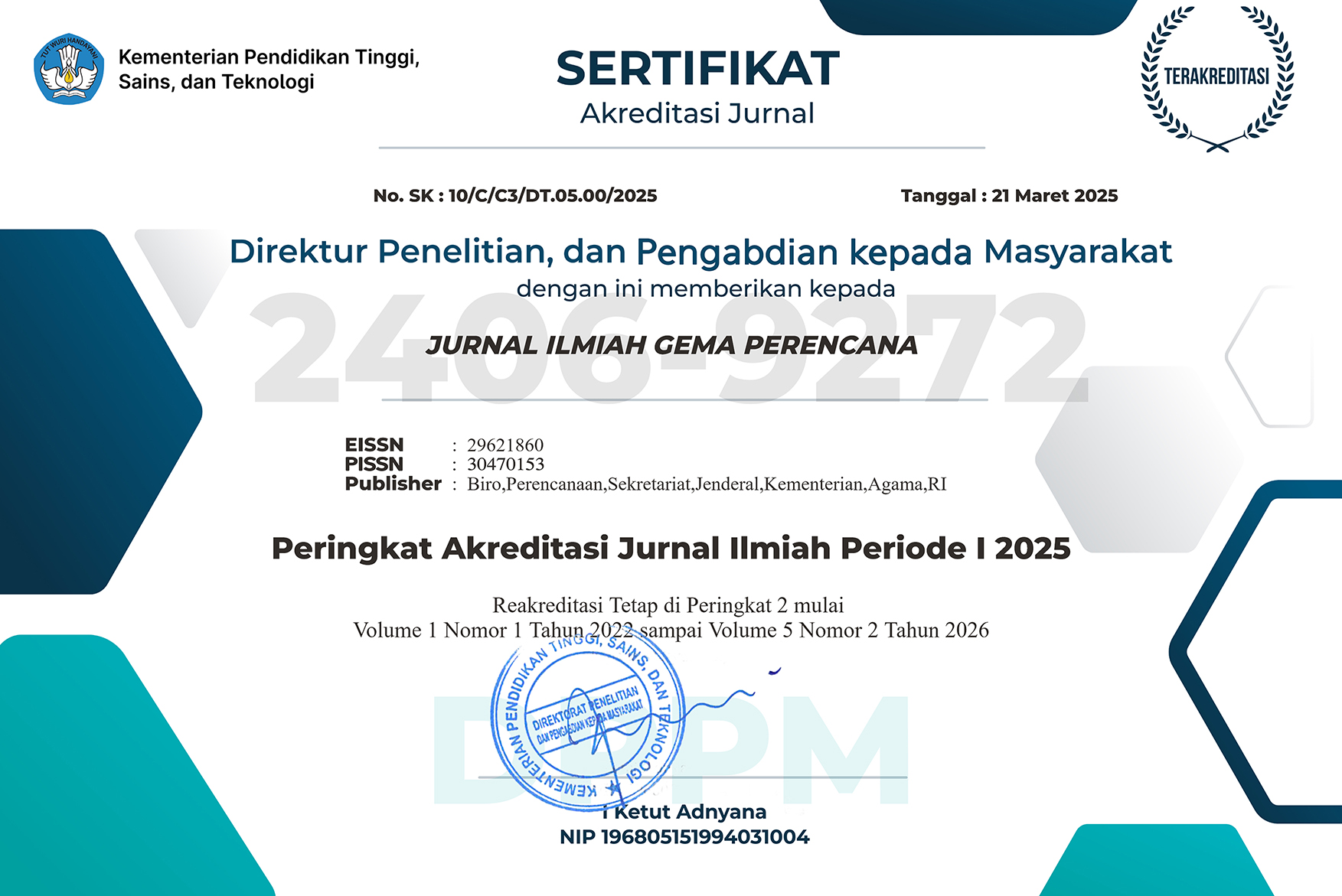
PUBLISHED BY: POKJANAS Collaborate BIRO PERENCANAAN KEMENAG RI
Licensed By: Attribution 4.0 International License

